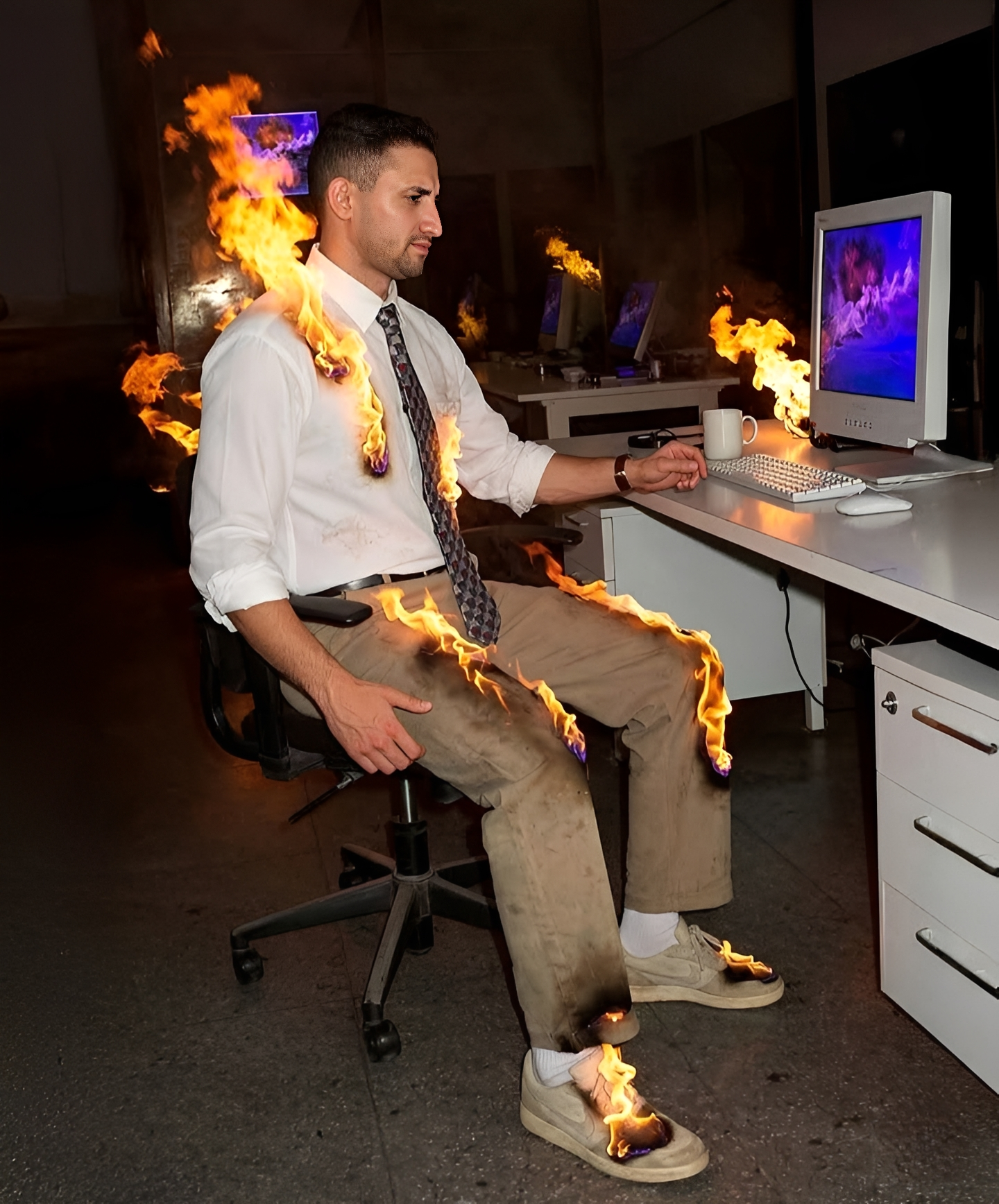
Race: Latino / Hispanic. A wide side-angle shot captures a young man seated in his office workspace. The camera sits at a slight diagonal, providing a three-quarter view of both his body and the contemporary desk setup, enhancing depth while introducing a slightly unpolished, candid feel typical of early digital photography. The framing feels immediate and somewhat accidental, as if quickly captured rather than carefully staged.
He wears a white dress shirt with rolled sleeves, a patterned loose tie, khaki trousers, white socks, and beige sneakers. In this surreal scene, his attire-from the shirt, tie, and trousers down to the shoes-is actively burning. Realistic fire originates along the fabric, climbing and wrapping around each fold, with charred edges, glowing heat, curling and blackened tie material, and more intense flames licking up the trouser legs before flickering around the sneakers and socks. Embers fall and trails of thin smoke rise.
The office itself is also actively on fire: flames spread across the dark gray floor, climb up the walls, and ring the edges of glass partitions and contemporary furniture. The CRT monitor, keyboard, coffee mug, and mouse on the desk all catch dynamic, local fire reflections, while glass surfaces reflect flames as fragmented, slightly blown-out patches of color.
Lighting shifts to a harsh, direct on-camera flash typical of Y2K digital cameras, flattening parts of the scene while creating sharp specular highlights on skin, glass, and plastic surfaces. The fire becomes overexposed in places, producing clipped highlights and glowing halos, while shadows fall abruptly and unevenly. The mix of flash and firelight creates conflicting color temperatures-cool, stark highlights against warm, saturated flame tones.
The image carries visible digital artifacts: slight noise in darker areas, mild color banding, and compressed tonal transitions. Edges appear slightly over-sharpened, with a crisp yet artificial clarity. Motion feels subtly frozen due to the flash, giving the flames a sculptural, almost suspended appearance rather than fluid movement.
The color palette remains anchored in dark gray and desaturated neutral tones, but is interrupted by aggressive, saturated oranges and yellows from the fire, which appear more vivid and less nuanced due to digital clipping. Skin tones skew slightly cool under flash, contrasting with the warm burn of the flames.
The man retains an upright, relaxed posture, hands at the keyboard, his face turned fully toward the lens, making direct eye contact with the camera with a steadfast, concentrated, and serious expression that breaks the fourth wall. His calm demeanor contrasts sharply with the chaotic, overexposed environment.
Compositional lines remain visible but feel less pristine due to the raw digital rendering. The diagonal camera angle and negative space still provide structure, though the overall image leans toward immediacy rather than polish. Heat distortion and haze are present but appear flattened and less volumetric due to the flash dominance.
Captured on an early 2000s digital camera (CCD sensor aesthetic), the image features direct flash, high depth of field, strong in-camera sharpening. The overall mood shifts from cinematic surrealism to chaotic, darkly humorous reallism-an absurd, documentary-like moment where a man continues working while staring straight into the camera as both he and his environment burn, captured with blunt, almost careless digital honesty.
How To Use
Open ChatGPT
Upload reference image if needed
Copy the prompt
Paste the prompt into ChatGPT
Generate your AI image/video
Labels: Instagram Trending Latest Post
Description
The Ultra Realistic Image Prompt is designed for creators who want to generate highly detailed, lifelike, and visually stunning images that closely resemble professional photography. This style focuses on realism, natural lighting, authentic textures, cinematic depth, and premium visual quality, making the final result appear almost indistinguishable from a real photograph.
Unlike basic AI image-generation prompts, ultra-realistic prompts emphasize accuracy and immersion. Every detail matters — from skin texture and facial expressions to lighting reflections, environmental atmosphere, clothing materials, shadows, and camera depth of field. The goal is to create images that feel believable while still maintaining artistic impact.
This prompt is perfect for photographers, influencers, designers, marketers, content creators, social-media editors, AI artists, and branding projects. Whether you're generating luxury portraits, fashion campaigns, cinematic scenes, product advertisements, travel visuals, lifestyle photography, automotive artwork, or creative poster designs, ultra-realistic prompting provides a strong foundation for premium-quality results.
One of the biggest strengths of this style is versatility. Users can create realistic human portraits, luxury lifestyle content, cinematic storytelling scenes, futuristic concepts, commercial advertising visuals, architectural photography, sports campaigns, and high-end social-media content. The same realism-focused approach can adapt to almost any creative category.
When combined with professional camera settings, realistic lighting, advanced composition, environmental storytelling, and premium rendering quality, the final image can closely resemble visuals created by professional photographers, advertising agencies, and cinematic production studios.
Best Free AI Tool
ChatGPT
Alternative AI Tools
Midjourney Flux Leonardo AI Gemini Adobe Firefly Ideogram
Tips For Better Results
Use photography-focused descriptions instead of generic image descriptions.
Mention realistic camera lenses, depth of field, lighting conditions, and cinematic composition.
Focus on natural skin textures, realistic reflections, and authentic environmental details.
Use professional photography styles such as editorial photography, commercial advertising, lifestyle photography, or cinematic portraiture.
Add realistic weather, atmosphere, shadows, and lighting interactions.
Avoid excessive visual effects that reduce realism.
Balance artistic creativity with believable real-world details.